What Happened in the Markets in September 2026
September saw mixed markets as inflation, higher energy prices and interest-rate hikes weighed on investors. Trade tensions and geopolitical uncertainty remain key risks ahead.

Written by
Ryan Gubic
Published on
2
Oct 2026
Copy link
Last Month in the Markets: September 1st – 30th, 2026
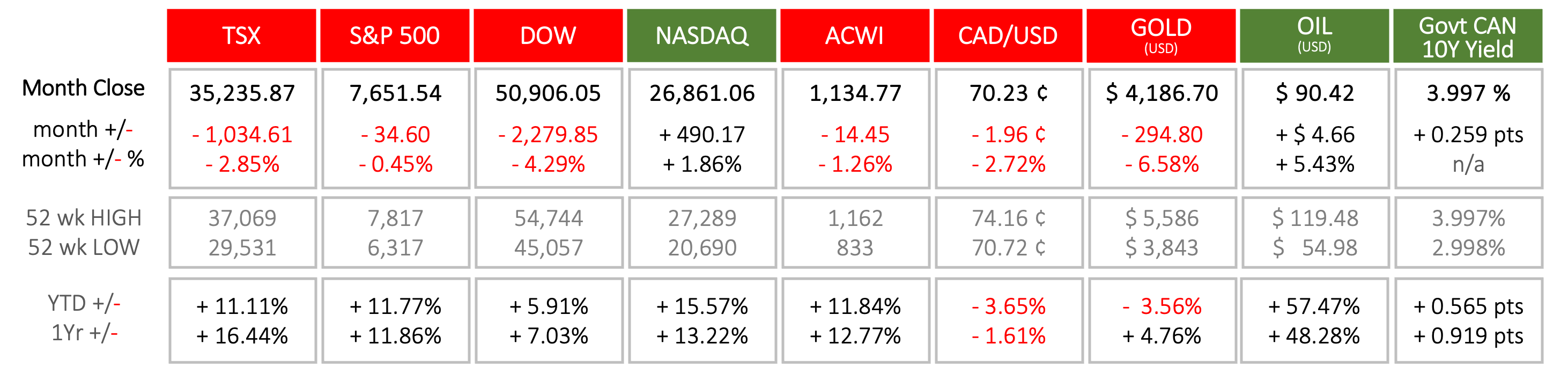
Index returns based on index value (source: Bloomberg https://www.bloomberg.com/markets, MSCI https://www.msci.com/end-of-day-data-search and ARG Inc. analysis. Price returns are reflected)
Last Quarter in the Markets: July 1st - September 30th, 2026

Index returns based on index value (source: Bloomberg https://www.bloomberg.com/markets, MSCI https://www.msci.com/end-of-day-data-search and ARG Inc. analysis. Price returns are reflected)
What happened in September?
Last month was disappointing for equity investors concentrated in the North America. A slightly time frame of the last quarter presented better results for those same investors.
The major influences over the last month and quarter have not changed. Inflation remained at elevated levels that caused the U.S. Federal Reserve and the European Central Bank (ECB) to increase policy interest rates. Inflation is being driven by the increased prices for energy, more specifically the prices for crude oil, gasoline and diesel fuel, caused by the ebb and flow of the U.S./Iran war. For families seeking professional wealth management in Calgary, understanding what drives market returns, and how those developments impact your long-term financial plan, is where working with a trusted Personal CFO can make all the difference.
What’s ahead for October and beyond?
Interest rates are expected to increase over the next quarter and year as inflation is expected to remain above goal for the Bank of Canada (BoC), Federal Reserve and ECB. The BoC and Fed will release interest rate decisions on October 28th, December 9th and January 27th. Over the course of those three announcements the likelihood of another Fed rate hike increases substantially according to CME's FedWatch tool.
The price of energy will continue to contribute substantially to inflation and interest rate decisions as Middle East tension remains elevated, and shipping routes are threatened.
Trade tensions will also affect inflation rates as tariffs and bans affect international trade between Canada and the U.S.
The upcoming mid-term election in the United States could motivate softening of rhetoric in the short-term, or change policy and its implementation if the Democrats achieve a majority in the House, Senate or both.
Each of these economic influences remain unpredictable, and individually or collectively could drive volatility for investors.
Events that influenced markets in September included:
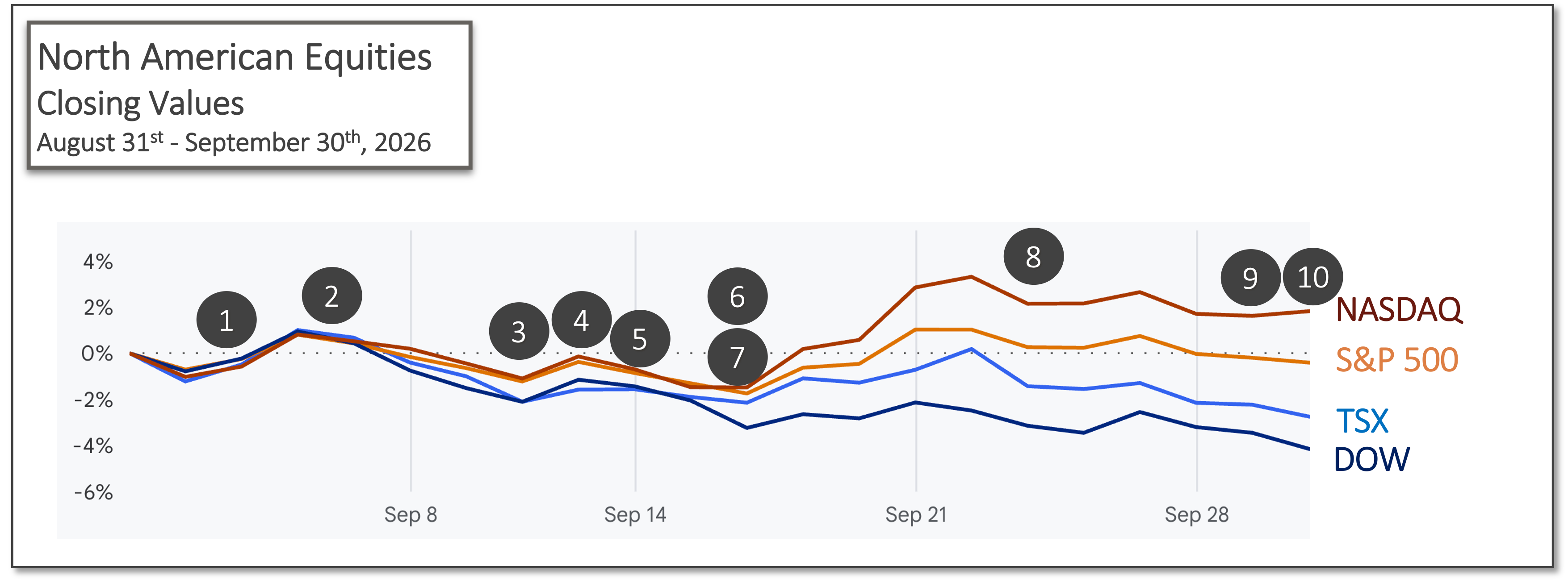
(source: Bloomberg https://www.bloomberg.com/marketsand ARG Inc. analysis)
1. September 2nd – Bank of Canada kept rates unchanged
The Bank of Canada held its policy interest rate, the overnight rate, steady at 2¼%. The Bank’s cited the continuing conflict in the Middle East and the breakdown of trade and tariff negotiations between Canada and the U.S. Both situations were labelled as “fluid”. BoC announcement
2. September 4th – Canadian employment declined in August
The Canadian job market suffered serious setbacks in August. According to StatsCan’s Labour Force Survey(LFS), employment declined by 42,000. Reuters survey of analysts had predicted a small increase in total employment. The unemployment rate was unchanged at 6.4%. CBC and LFS
The U.S. Employment Situation Summary portrayed a different view as total nonfarm payroll employment increased by 162,000 in August. Analysts expected a more modest addition of 53,000 jobs. CNBC and ESS
3. September 10th – Europe’s interest rates increased on inflation concerns
The European Central Bank (ECB) raised its benchmark by ¼ percent (25 basis points). The ECB release included, “The conflict in the Middle East continues to generate inflation pressures, and inflation is set to remain well above target for an extended period.” ECB release
4. September 11th – American inflation rose again
U.S. consumer inflation continued to rise in August according to the Bureau of Labor Statistics. After rising 0.1% in July the Consumer Price Index (CPI) rose 0.4% in August. The index for gasoline rose almost 4% in August and accounted for one-third of the increase for the month. Over the last 12 months the CPI rose 3.4%, which is the same increase as the 12 months ending July. CPI release
5. September 14th – Canadian inflation remained at 3% in August
The Consumer Price Index reported that prices have risen 3.0% on a year-over-year basis in August, the same level seen in July. The price of gasoline rose at a slower pace in August than July and was offset by higher prices for travel and rent. StatsCan CPI CBC and CPI
6. September 16th – U.S. rates raised to combat inflation
The Federal Reserve increased its benchmark interest rate by ¼ percent (25 basis points), the first increase in 3 years. The conclusion of the mid-September announcement was concise, “Inflation remains elevated. Today's policy action will support a timelier return to the Committee's 2 percent goal. The Committee will deliver price stability.” Fed statement
The Fed also released its Summary of Economic Projections that includes the “dot plot” showing committee members’ predictions for interest rates. Members believe that another one or two rate increases are likely before the end of 2026. CNBC and rates
7. September 16th – Canada and the European Union explored a deeper relationship
Prime Minister Mark Carney travelled to meet with the European Union, where the EU offered its first-ever associate membership to Canada. The details of this relationship have not been defined, nor agreed. It is aligned with the Canadian government’s stated goal of reducing our economy’s reliance on bilateral trade with the U.S. CNBC and Canada/EU
8. September 24th – Canadian retail sales declined
A key component of the economy, retail sales, decreased 0.7% in July to $73.7 billion. The decline was led by general merchandise retailers and was broad-based as eight of nine subsectors contributed to the slow-down. In June, retail sales had increased 1.2%. StatsCan release
9. September 29th – Canadian economic growth stalled
Real Gross Domestic Product (GDP) was unchanged in July after growth 0.4% in June. Neither Goods-producing nor Services-producing industries were able to generate growth in July. One bright spot was the construction sector which saw its fourth consecutive month of growth after rising 1.3% in July. StatsCan GDP release
10. September 30th – U.S. inflation remained far above goal
The Bureau of Economic Analysis reported that the Personal Consumption Expenditures (PCE) price index, the Federal Reserve’s preferred inflation indicator, increased 0.3 percent in August. Compared to same month in 2025, the PCE increased 3.4 percent and core PCE, excluding food and energy, increased 3.0 percent. Both measures are well above the Fed’s 2 percent goal. PCE release
Ryan Gubic is the founder of MRG Wealth Management Inc. operating as MRG Wealth (“MRG”) and is a Portfolio Manager with MRG investments of Aligned Capital Partners Inc. (“ACPI”). The opinions expressed are not necessarily those of MRG, ACPI, or Ryan Gubic. This material is provided for general information and the opinions expressed and information provided herein are subject to change without notice. Every effort has been made to compile this material from reliable sources however no warranty can be made as to its accuracy or completeness. Before acting on the information presented, seek professional financial advice based on your personal circumstances. ACPI is a full-service investment dealer and a member of the Canadian Investor Protection Fund (“CIPF”) and the Canadian Investment Regulatory Organization (“CIRO”). Investment services are provided through MRG Investments, an approved trade name of ACPI. Only investment-related products and services are offered through MRG Investments of ACPI and covered by the CIPF. Financial planning and insurance services are provided through MRG. MRG is an independent company separate and distinct from MRG Investments of ACPI.
Dollars and Sense
Discover more
Dive into some advice directly from our Founder and Personal CFO.
What Happened in the Markets in August 2026