

What Happened in the Markets in August 2026
August was a strong month for markets, with major North American indexes rising despite ongoing trade tensions, persistent inflation and uncertainty over interest rates.

Written by
Ryan Gubic
Published on
3
Sep 2026
Copy link
Last Month in the Markets: August 3rd – 31st, 2026
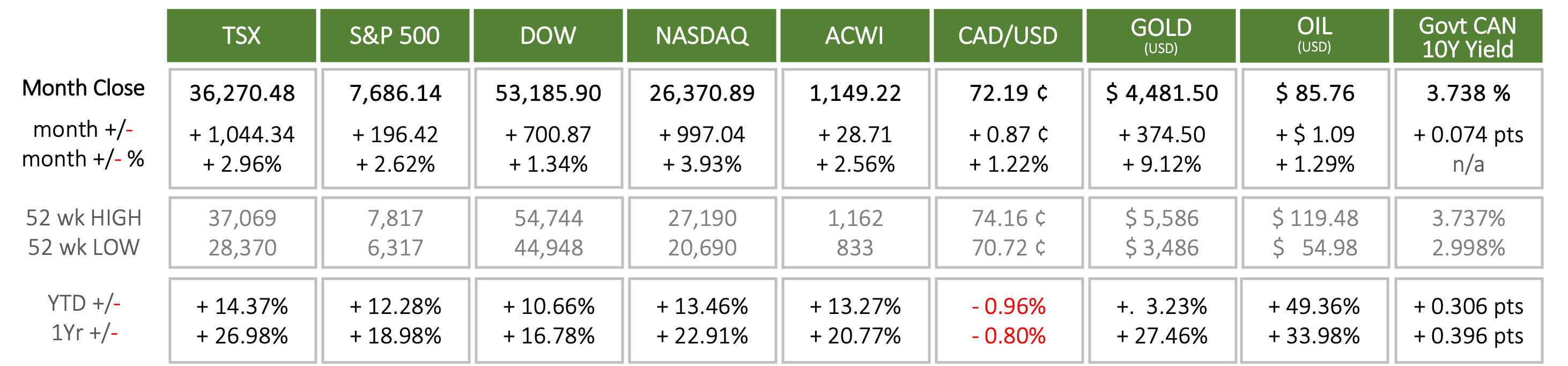
Index returns based on index value (source: Bloomberg https://www.bloomberg.com/markets, MSCI https://www.msci.com/end-of-day-data-search and ARG Inc. analysis. Price returns are reflected)
What happened in August?
It was the first all-green month for our grid, above, in more than two years. Despite many potential negative economic factors, North American equity indexes and the All-Country World Index moved upward. Canadian consumer prices above goal, but not significantly, and domestic net job creation and Gross Domestic Product growth remained resilient. The U.S. economy is not performing as well with inflation far above goal and job creation waning.
Both the Bank of Canada and the U.S. Federal Reserve are focused on price stability and maximizing employment as their mandates. The threat of rising interest rates in the in the United States, and the influence that higher American rates will deliver around the world, failed to dampen market enthusiasm for stocks. In August, the TSX and S&P 500 rose nearly 3%, the Dow 1½% and the NASDAQ almost 4%.
August concluded with three federal byelections that elected only Liberal candidates. Initial analysis suggested that the election results validated Prime Minister Carney’s handling of the trade negotiations with the United States. The break-down of negotiations between Canada and the U.S. dominated news here and will continue to do so.
What’s ahead for September and beyond?
In addition to trade and tariff negotiations, which were not occurring as of August 31st, the U.S. war with Iran, the price of oil’s effect on inflation, and interest rates will be under scrutiny for market watchers.
After the Bank of Canada held its policy interest rate unchanged, as expected, on September 2nd, the next scheduled interest rate announcement from the U.S. Federal Reserve will occur two weeks later, on September 16th. The chances that U.S. rates do not increase this calendar year are very low according to CME's FedWatch tool. The final two rate dates in 2026 for both institutions are October 28th and December 9th.
Canadian rates will be guided by the effects of the trade war started by Donald Trump on domestic inflation and jobs. A fine balance will be required if inflation rises and employment stagnates. Inflation is tempered by higher rates and employment growth favours lower capital costs.
More than central bank rates drive lending rates, bond yields, which rise as bond prices fall, have reached levels not seen in two decades. According to a New York Times article several factors in major economies are conspiring together to threaten global economic health through as borrowing costs increase.
Lastly, the escalation of the conflict in the Middle East has pushed oil prices higher at the end of August and the beginning of September. The uncertainty of the diplomatic and military situation will likely spread uncertainty in markets. For families seeking professional wealth management in Calgary, understanding what drives market returns, and how those developments impact your long-term financial plan, is where working with a trusted Personal CFO can make all the difference.
Events that influenced markets in August included:
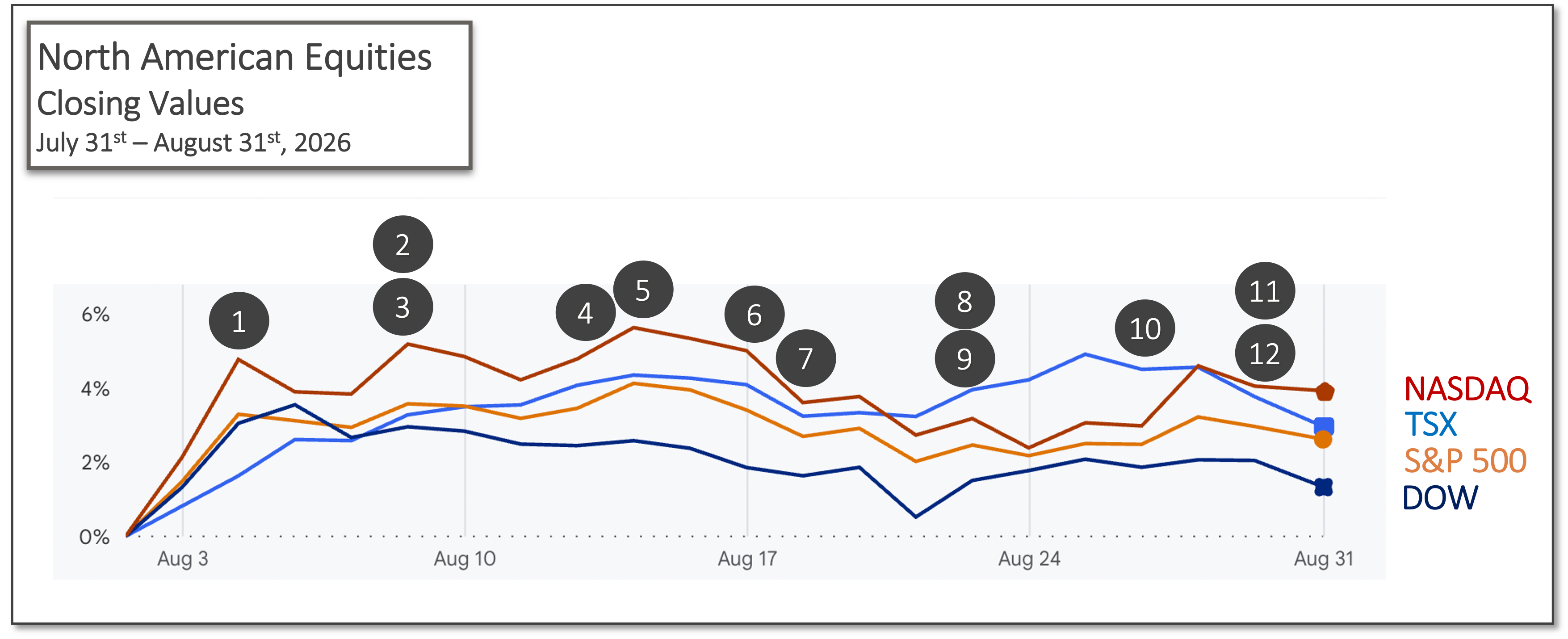
(source: Bloomberg https://www.bloomberg.com/marketsand ARG Inc. analysis)
1. August 4th – Canada’s trade surplus grew, again
The Canadian merchandise trade surplus widened slightly from $3.7 billion in May to $3.9 billion in June. Merchandise exports increased 0.4%, more than the increase in imports at 0.2%. June was the fourth consecutive month with a monthly surplus. StatsCan release
2. August 7th – Canadian jobs show continued resilience
Canada’s economy added 75,000 jobs in July according to StatsCan's Labour Force Survey. Gains were split between full and part-time employment, and over 180,000 jobs have been added since April. The unemployment rate fell for the third consecutive month to 6.4 percent, its lowest level in 2 years. It is a much more favourable summer job market for students. CBC and jobs
3. August 7th – U.S. employment slipped
“Both nonfarm payroll employment (-23,000) and the unemployment rate (4.1 percent) changed little in July” according to the Bureau of Labor Statistics’ Employment Situation Summary. Analysts had expected a gain of 83,000 for July. After downward revisions to previous months, the average monthly gain is down to 34,000.
4. August 12th – U.S. consumer inflation eased, but remained above goal
The Consumer Price Index (CPI) eased 0.1% to 3.4% on a year-over-year basis. On a monthly basis, prices increased 0.1% in July compared to a 0.4% increase in June. In July, shelter, food and food away from home contributed to the increase, while the energy index declined 1.5%. BLS CPI release
5. August 13th – Wholesale prices also eased, but is still high
U.S. Producer Price Index (PPI) in July rose 4.7% on a year-over-year basis down from 5.5% in June. The PPI measures the change in prices paid by producers and wholesalers, not consumers. The path of PPI is a good indicator of future CPI after wholesale inflation makes its way to consumers.
6. August 17th – Canadian inflation
The Canadian Consumer Price Index (CPI) rose 3.0% on a year-over-year basis in July, up from the 2.8% reading in June. Higher prices for gasoline and travel driven by World Cup attendees contributed to the acceleration in inflation. Food purchased from stores (+3.1%) helped to moderate the rise but remains above the headline CPI level. StatsCan CPI release CBC and CPI
7. August 18th – Trade talks extended
About 90 minutes before Trump’s 50% tariffs on more than $20 billion of Canadian imports were to take effect a three-day pause was announced by the President on social media. No details were released; negotiators have additional time to arrive at a comprehensive arrangement.
8. August 21st – Trade talks ended without any deal
The extra time did not facilitate a solution, and negotiations ended without a deal. The details from the Canadian perspective were communicated in an address by Prime Minister Carney. Among other details, Carney said that the Americans “asked too much and offered too little”.
9. August 21st – U.S. government debt breached $40 trillion
In news that will reverberate across global capital markets the U.S. federal debt rose to $40 trillion. The largest reported monthly deficit since the pandemic was $432 billion was in July 2026. As the U.S. debt has doubled in the last ten years, the cost of borrowing has risen more dramatically. The demand for capital by the U.S. government will support higher rates as will the Federal Reserve’s mandate to control inflation. Fed FOMC minutes
10. August 26th – U.S. inflation spiked in July
The Federal Reserve’s preferred inflation indicator, the Personal Consumption Expenditures price index (PCE), showed that consumer prices rose 3.7% compared to July 2026. The Fed’s goal for inflation is 2%. Core PCE, which excludes more volatile food and energy, rose 3.3% from one year ago. The Federal Reserve’s next rate decision is scheduled for September 16th and this report along with the next Employment Situation Summary due out next week will be the two most significant considerations. BEA PCE release CNBC and PCE
11. August 28th – Canada’s economy powered along in Q2
Canada’s Gross Domestic Product (GDP) grew 0.8% in the second quarter of 2026, which is an annualized rate of 3.3%. The rise in GDP reflected the 3.6% increase in exports, which were led by an increase in exports of passenger cars and light trucks. Auto production had declined in the preceding two quarters. With the introduction of higher U.S. tariffs for Canadian vehicles, the increase in production will be short lived after a period of increased production to beat the deadline. StatsCan GDP release CBC ad GDP
12. August 28th – Fed Chair warned inflation must be addressed
Based on Friday’s speech from Federal Reserve Chair, Kevin Warsh, at the annual Symposium in Jackson Hole, Wyoming it appears the Fed could increase sooner rather than later. CME’s FedWatch tool reacted with the likelihood of an increased rising above the prediction that it will remain unchanged.
Ryan Gubic is the founder of MRG Wealth Management Inc. operating as MRG Wealth (“MRG”) and is a Portfolio Manager with MRG investments of Aligned Capital Partners Inc. (“ACPI”). The opinions expressed are not necessarily those of MRG, ACPI, or Ryan Gubic. This material is provided for general information and the opinions expressed and information provided herein are subject to change without notice. Every effort has been made to compile this material from reliable sources however no warranty can be made as to its accuracy or completeness. Before acting on the information presented, seek professional financial advice based on your personal circumstances. ACPI is a full-service investment dealer and a member of the Canadian Investor Protection Fund (“CIPF”) and the Canadian Investment Regulatory Organization (“CIRO”). Investment services are provided through MRG Investments, an approved trade name of ACPI. Only investment-related products and services are offered through MRG Investments of ACPI and covered by the CIPF. Financial planning and insurance services are provided through MRG. MRG is an independent company separate and distinct from MRG Investments of ACPI.
Dollars and Sense
Discover more
Dive into some advice directly from our Founder and Personal CFO.
What Happened in the Markets in September 2026
