

What Happened in the Markets in July 2026
Markets navigated renewed Middle East tensions, higher oil prices and persistent inflation. The Bank of Canada and Fed held rates steady as economic growth remained resilient.

Written by
Ryan Gubic
Published on
5
Aug 2026
Copy link
Last Month in the Markets: July 1st – 31st, 2026
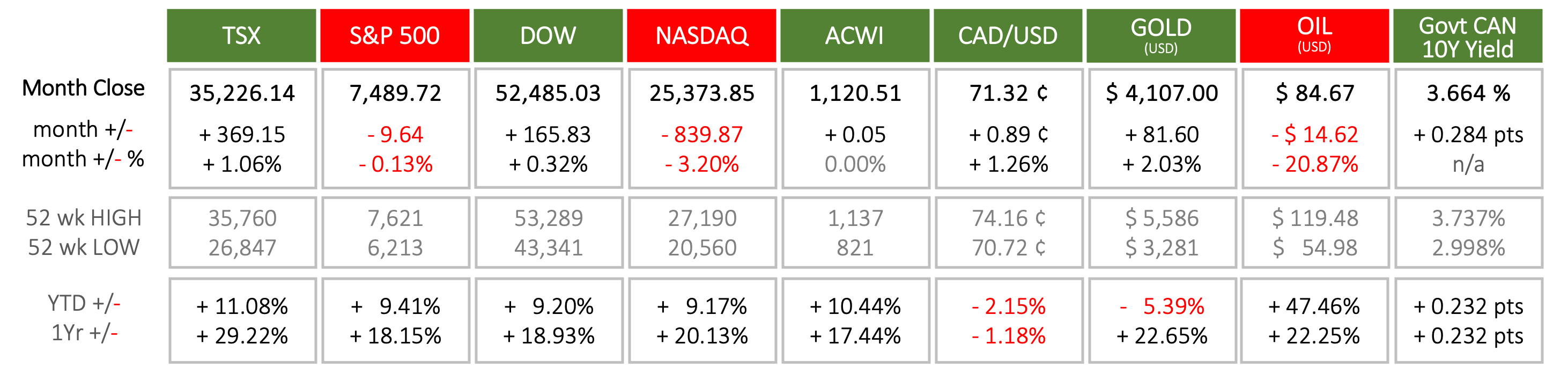
Index returns based on index value (source: Bloomberg https://www.bloomberg.com/markets, MSCI https://www.msci.com/end-of-day-data-search and ARG Inc. analysis. Price returns are reflected)
What happened in July?
As many expected the U.S./Iran war continues to occupy much of the attention for political and economic news and remained influential for markets. On July 8th, President Trump declared that the ceasefire was over after renewed military attacks, including drones and missiles, between the two countries. Iran launched strikes against U.S. interests across the region, and the U.S. responded by with attacks on nearly 150 targets. The blockade of Iranian ports was reimposed on July 14th, and Trump threatened to impose fees for ships in the Strait of Hormuz. On July 17th and 18th, 4 U.S. service members were killed. On July 26th the Pentagon updated its casualty calculations and process, while reporting 18 deaths and 624 wounded. Synopsis of key dates
By now, everyone is familiar with the effects of this conflict on the price of oil. After some diplomatic progress the military escalation reignited price increases beginning on July 7th and peaking on July 23rd. Despite price declines at the end of the month, the price of oil is more than 20% above prices in February prior to the bombing of Iran began six months ago. For families seeking professional wealth management in Calgary, understanding what drives market returns, and how those developments impact your long-term financial plan, is where working with a trusted Personal CFO can make all the difference.
What’s ahead for August and beyond?
Until the conflict in the Middle East subsides and reaches a stable peace, uncertainty and volatility will remain in markets. Eventually, the higher price of oil will become imbedded and change the course of corporate and economic growth, and longer-term inflation. The Bank of Canada and Federal Reserve will likely change course for interest rates if inflation remains high into the fall and winter. The predictions have increasingly turned to rate hikes for the Fed according to CME's FedWatch tool.
Events that influenced markets in July included:
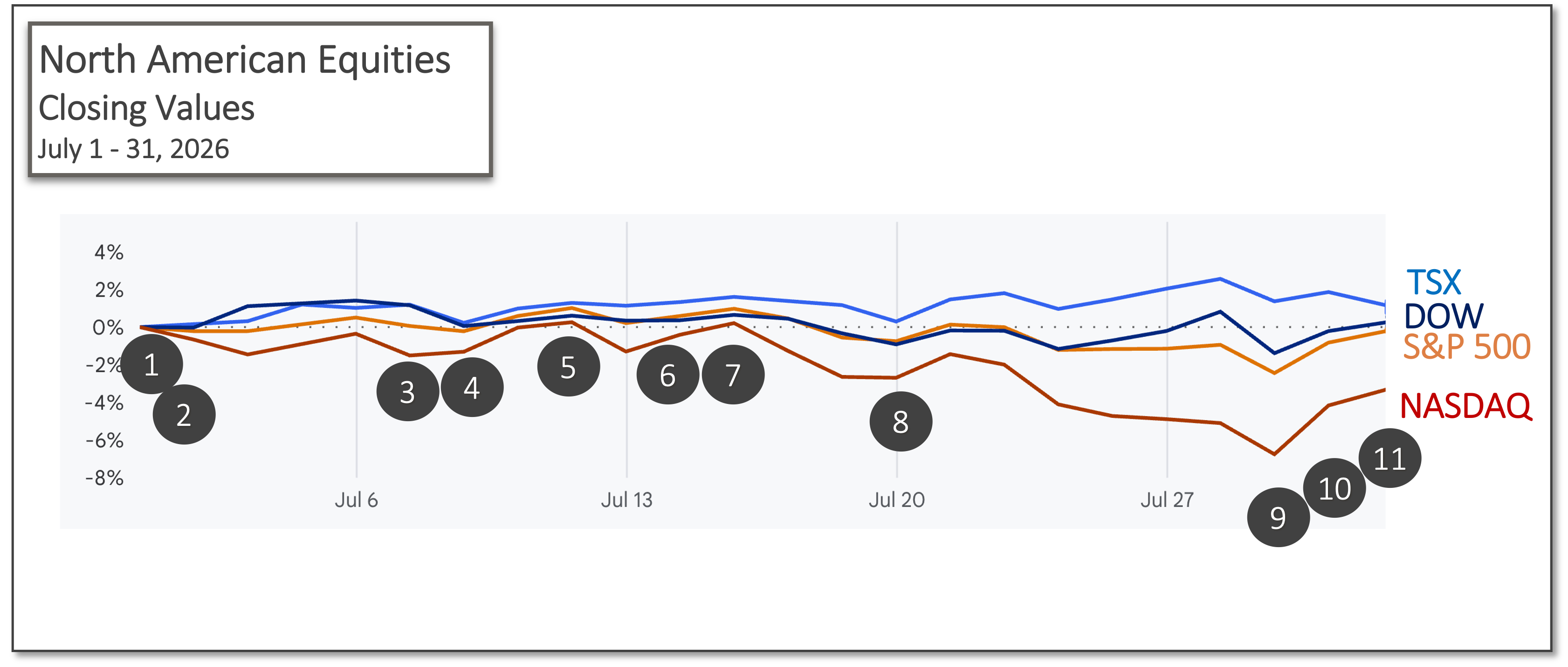
(source: Bloomberg https://www.bloomberg.com/marketsand ARG Inc. analysis)
1. June 30th – The growing Canadian economy led us into July
Real gross domestic product (GDP) grew 0.5% in April, after contracting 0.1% in March, on strength in both goods-producing (1.2%) and services-producing industries (+0.3%). The sectors driving growth were mining, quarrying, oil and gas extraction, the public sector and transportation and warehousing. StatsCan GDP release
2. July 2nd – U.S. jobs grew modestly
According to the U.S. Employment Situation Summary, total nonfarm employment grew by 57,000 in June. Most of the growth came from professional and business services (+36,000), social assistance (+25,000) and healthcare (+22,000). CNBC and EmpSit
3. July 7th – Canada’s trade surplus grew almost 25% and U.S. trade deficit jumped in May
The merchandise trade surplus widened to $4.2 billion in May from $3.4 billion in April as exports grew more than imports. It was the third consecutive month with a trade surplus. StatsCan release
The U.S. trade deficit widened to $77.6 billion in May up from $54.6 billion in April, a 42% increase. The deficit grew as exports from the U.S. fell 3.2% and imports to the U.S. increased 3.3%, which accounted for the widening, net-negative trade gap. BEA trade release CNBC
4. July 8th – U.S./Iran ceasefire ended
After much disagreement whether full negotiations were underway, and after many rounds of bilateral attacks between the two countries, President Trump declared that the ceasefire had ended. Indications that diplomatic communications continued. Politico and ceasefire
5. July 10th – Canadian jobs and unemployment rate improved slightly in June
StatsCan released its Labour Force Survey for June that showed employment increased slightly, up 18,000, and the unemployment rate declined by 0.1 percentage points to 6.5%. Employment increased for youth and core aged people while the number of jobs for older Canadians fell.
6. July 14th - U.S. inflation slowed in June compared to May and remained above goal
On a month-over-month basis U.S. inflation reversed in June. The Consumer Price Index decreased 0.4% in June after rising 0.5% in May. On an annual basis it has slowed. Over the last 12 months, the all-items index increased 3.5%. In May, the year-over-year consumer inflation rate was 4.2%. Much of the change in the headline rate is attributed to the 5.7% fall in the index for energy in June compared to 3.9% increase in May, 3.8% in April and 10.9% in March. The all-items index less food and energy was unchanged between June and May at 2.6%. BLS release CNBC and CPI
7. July 15th – Bank of Canada held rates unchanged and released its Monetary Policy Report
The Bank of Canada maintained its overnight rate at 2.25%, the Bank Rate at 2.5% and the deposit rate at 2.20%. The rates were last changed on October 29, 2025, when they were lowered to their current levels, and have remained unchanged after six subsequent interest rate decisions. In the most recent decision, the Bank noted higher oil prices, slowing global Gross Domestic Product growth, “choppy” Canadian GDP growth, buoyant global equity markets, risen U.S. bond yields, solid consumer spending, and higher consumer inflation levels domestically and around the world.
The Bank of Canada also released its Monetary Policy Report (MPR) that reiterated the situation described above. It included, “The evolution of Canada’s trade relationship with the United States and the war in the Middle East remain the two most important risks to the outlook for inflation.” BoC announcement CBC and Boc
8. July 20th – Canadian consumer inflation slowed in June compared to May
Canadian’s consumer prices increased 2.8% in June on a year-over-year basis after May’s reading of 3.2%. Excluding gasoline from the inflation calculations, the Consumer Price Index (CPI) in June and May was unchanged at 2.2%. StatsCan CPI release
9. July 29th – Fed holds benchmark rate unchanged
The Federal Reserve held its federal funds rate steady in a range of 3½ to 3¾ percent. Although employment growth and unemployment are satisfactory, the rate of consumer inflation had 3 of its 12 committee members vote for a rate increase. Fed announcement CNBC and Fed
10. July 30th – U.S. inflation far above 2% target, GDP growth slowed
The Federal Reserve’s preferred inflation indicator, the Personal Consumption Expenditures Price Index (PCE) has risen 3.7% compared with June 2025. Excluding food and energy, Core PCE, rose 3.3%, both topline and core inflation are well above the Fed’s 2% target. PCE release
U.S. Gross Domestic Product (GDP) rose 1.5% on an annualized basis in the second quarter, which is a slow-down compared to Q1 2026. GDP release
11. July 31st – Canadian GDP rebounded for second consecutive month
In Canada, GDP grew 0.3% in May, the second consecutive month of growth as both goods and services industries expanded. The increase was led by mining, quarrying and oil and gas extraction for the last two months. The government, construction, real estate, rental and leasing, manufacturing, finance and insurance, transportation and warehousing were among the sectors delivering increased levels of economic activity. StatsCan GDP release
Ryan Gubic is the founder of MRG Wealth Management Inc. operating as MRG Wealth (“MRG”) and is a Portfolio Manager with MRG investments of Aligned Capital Partners Inc. (“ACPI”). The opinions expressed are not necessarily those of MRG, ACPI, or Ryan Gubic. This material is provided for general information and the opinions expressed and information provided herein are subject to change without notice. Every effort has been made to compile this material from reliable sources however no warranty can be made as to its accuracy or completeness. Before acting on the information presented, seek professional financial advice based on your personal circumstances. ACPI is a full-service investment dealer and a member of the Canadian Investor Protection Fund (“CIPF”) and the Canadian Investment Regulatory Organization (“CIRO”). Investment services are provided through MRG Investments, an approved trade name of ACPI. Only investment-related products and services are offered through MRG Investments of ACPI and covered by the CIPF. Financial planning and insurance services are provided through MRG. MRG is an independent company separate and distinct from MRG Investments of ACPI.
Dollars and Sense
Discover more
Dive into some advice directly from our Founder and Personal CFO.
What Happened in the Markets in August 2026