

Monthly Market Update - February 2026
February markets were shaped by mixed economic data, steady interest rates, easing inflation, and geopolitical tensions. Late-month Middle East conflict increased volatility, pushing oil and gold higher.

Written by
Ryan Gubic
Published on
10
Mar 2026
Copy link
Last Month in the Markets: February 2nd – 27th, 2026
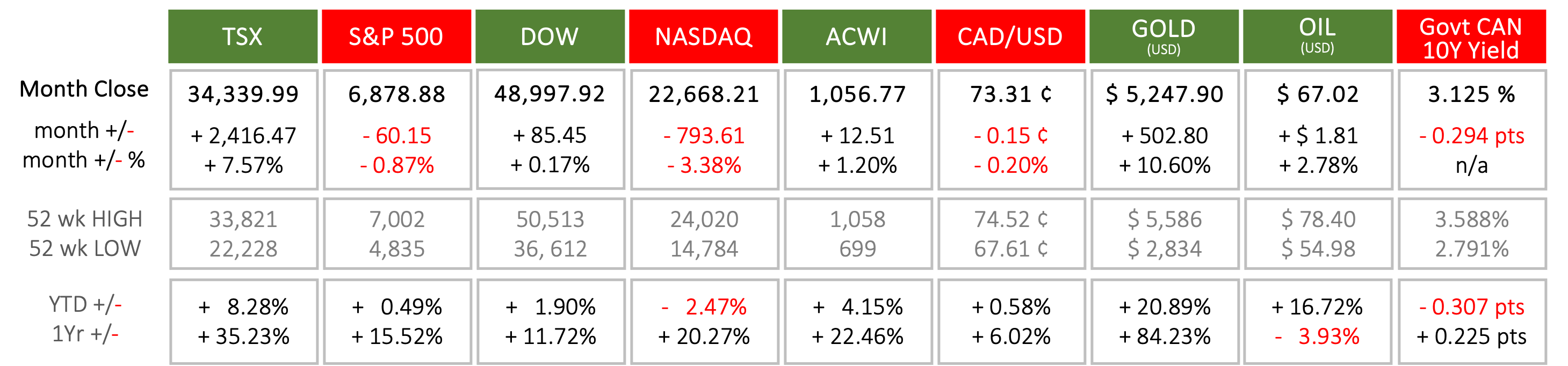
Index returns based on index value (source: Bloomberg https://www.bloomberg.com/markets, MSCI https://www.msci.com/end-of-day-data-search and ARG Inc. analysis. Price returns are reflected)
What happened in February?
The economic events of February were overshadowed by the political and military actions that occurred on the last day of the month following the close of markets on February 27th. If you have questions, let's talk and discover the wealth management Calgary families trust to have clarity, confidence, and freedom in their financial life.
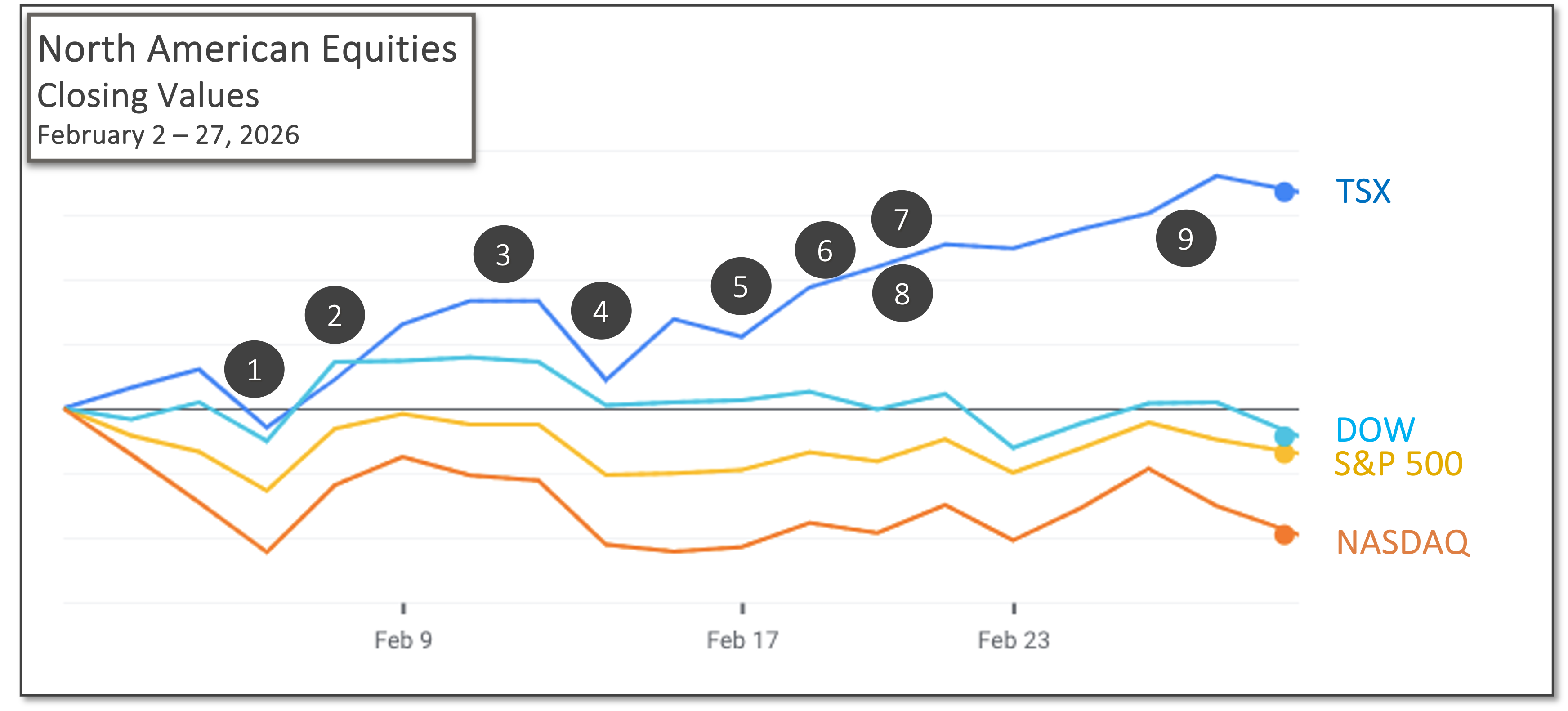
(source: Bloomberg https://www.bloomberg.com/marketsand ARG Inc. analysis)
Nonetheless, events that influenced markets in February included:
1. February 5th – European Central Bank held rates unchanged
The European Central Bank held its three key interest rates unchanged. “The outlook is still uncertain, owing partially to ongoing global trade policy uncertainty and geopolitical tensions”, according to their monetary policy decision.
2. February 6th – Canadian employment and American unemployment disappointed
“Employment edged down in January (-25,000; 0.1%) and the employment rate decreased 0.1 percentage points to 60.8%” according to its most recent Labour Force Survey. CBC and LFS
In 255 of 387 U.S. metropolitan areas the unemployment rate in December 2025 was higher than one year ago according to the Bureau of Labor Statistics. National employment was 4.1%, up from 3.8% in December 2024. BLS Metro Employment Report - Dec 2025
3. February 11th – U.S. monthly jobs growth highest of Trump’s second term
The U.S. Bureau of Labor Statistics (BLS) released their delayed Employment Situation Summary, “Total nonfarm payroll employment rose 130,000 in January, and the unemployment rate changed little at 4.3 percent.” For context, in 2023, 2024 and 2025, monthly job gains averaged 210,000, 122,000 and 15,000, respectively. CNBC and Employment
4. February 13th – U.S. CPI and corporate performance improved
The U.S. Consumer Price Index rose 0.2 percent in January, and 2.4 percent on a year-over-year basis according to the release from the BLS. The latest figures represent an improvement, but the year-over-year rate is above the Federal Reserve’s goal of a 2 percent average. CNBC and CPI
5. February 17th – Canadian consumer prices dipped
Canada’s Consumer Price Index (CPI) rose 2.3% on a year-over-year basis in January, down slightly from its 2.4% increase in December. The price of gasoline, which has fallen almost 17% since January 1025, was the largest contributor to the deceleration in headline inflation. Core inflation, which excludes food and energy, rose 2.4% last month, and continues to edge downward toward the Bank of Canada’s 2% goal. StatsCan and CPI CBC and CPI
6. February 19th – Tariffs had no impact on U.S. trade balance, increased Canada’s deficit
The U.S. trade deficit was $901.5 billion in 2025, down just 0.2% (-$2.1 billion). The future of Trump’s tariffs was confused by a U.S. Supreme Court decision that the use of the International Emergency Economic Powers Act (IEEPA) to impose tariffs was deemed unlawful in a 6-3 ruling. Trump immediately responded with 10% tariffs, then increased them to 15%, using different legislation. Trade Deficit release SCOTUS decision
In the wake of Trump’s tariffs, Canada’s trade deficit grew to $31.3 billion in 2025, the highest level since the pandemic. Exports to the U.S. dropped 5.8%, and imports from the U.S. fell 2.9% and the trade surplus with the U.S. narrowed to $81.6 billion in 2025, down from $101.3 billion in 2024. NP and trade deficit
7. February 20th – U.S. GDP growth slowed in Q4
U.S. Gross Domestic Product was up just 1.4% in the fourth quarter of 2025. Economic growth was well below expectations with government spending dropping temporarily due to the U.S. government shutdown. CNBC and GDP
8. February 20th – U.S. inflation rose again
The Federal Reserve’s preferred inflation indicator, the Personal Consumption Expenditures Price Index, increased as it rose 0.1% to 2.9% in December. BEA and PCE
9. February 27th – Canadian GDP fell in Q4
Canadian real gross domestic product (GDP) declined 0.2% in the fourth quarter of 2025, after rising 0.6% in the third quarter. Much of last year’s decline can be attributed to decreased exports to the U.S. StatsCan GDP release
What’s ahead for March and beyond?
February ended with the joint U.S./Israel attacks against Iran’s leadership, nuclear program and property. Iran responded by attacking American and Israeli interests across the region regardless of their location.
Markets responded quickly on the first trading days of March. Monday saw gold and oil rise sharply. North American equity markets were flat on March 2nd, and then tumbled at-the-open on the next day.
In the medium and long-term, inflation, employment, economic growth and monetary policy will continue to influence markets. In the near-term, the conflict across the middle east region and the direct effect on energy supply and prices will provide significant impact.
The VIX Volatility Index that measures the market’s expectations of near-term price changes in the S&P 500 has also risen sharply. Volatility will remain elevated as long as the conflict continues, and defensive and offensive actions are uncertain.
Ryan Gubic is the founder of MRG Wealth Management Inc. operating as MRG Wealth (“MRG”) and is a Portfolio Manager with MRG investments of Aligned Capital Partners Inc. (“ACPI”). The opinions expressed are not necessarily those of MRG, ACPI, or Ryan Gubic. This material is provided for general information and the opinions expressed and information provided herein are subject to change without notice. Every effort has been made to compile this material from reliable sources however no warranty can be made as to its accuracy or completeness. Before acting on the information presented, seek professional financial advice based on your personal circumstances. ACPI is a full-service investment dealer and a member of the Canadian Investor Protection Fund (“CIPF”) and the Canadian Investment Regulatory Organization (“CIRO”). Investment services are provided through MRG Investments, an approved trade name of ACPI. Only investment-related products and services are offered through MRG Investments of ACPI and covered by the CIPF. Financial planning and insurance services are provided through MRG. MRG is an independent company separate and distinct from MRG Investments of ACPI.
Dollars and Sense
Discover more
Dive into some advice directly from our Founder and Personal CFO.

What Happened in the Markets in September 2026