

What Happened in the Markets in March 2026
March markets were driven by the U.S.–Iran conflict—equities fell early, oil surged, then rebounded on peace talks; volatility, inflation risks, and rate uncertainty remained elevated.

Written by
Ryan Gubic
Published on
6
Apr 2026
Copy link
Last Month in the Markets: March 2nd – 31st, 2026
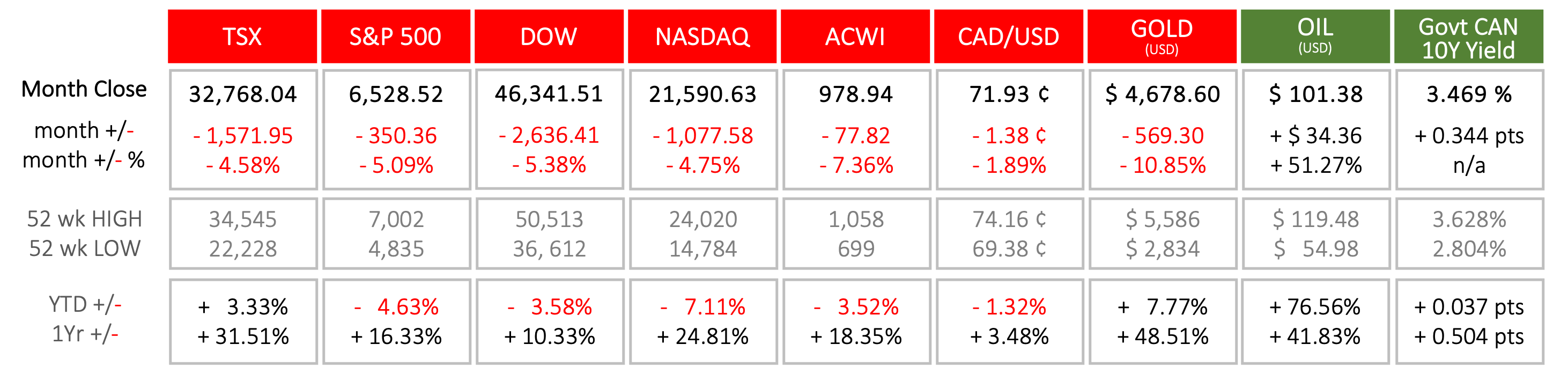
Index returns based on index value (source: Bloomberg https://www.bloomberg.com/markets, MSCI https://www.msci.com/end-of-day-data-search and ARG Inc. analysis. Price returns are reflected)
What happened in March?
Nearly every market move was controlled, or at least heavily influenced, by the U.S. attack on Iran that began at the end of February. Two days of war preceded the opening of trading on March 2nd, and the war continued unabated to the end of the month and beyond. The first three weeks of the month were a nearly continuous series of losses for North American equity indexes, where they lost between 4½ and 9%.
On March 23rd Donald Trump mentioned that discussions to end the war with Iran’s leadership were progressing well. Markets reacted immediately. Oil prices dropped more than 10%, gold fell 5%, and then equities jumped 2% after the opening bell on the 24thhighlighting the relationship between uncertainty-driven commodity prices and equity values. Progress on negotiations that would allow oil shipments through the could reopen the Strait of Hormuz to oil shipments will greatly influence oil prices and equity valuesin the near-term.
Until a full resolution to the conflict is achieved expect the political and military uncertainty the VIX Volatility Index to maintain its high level.
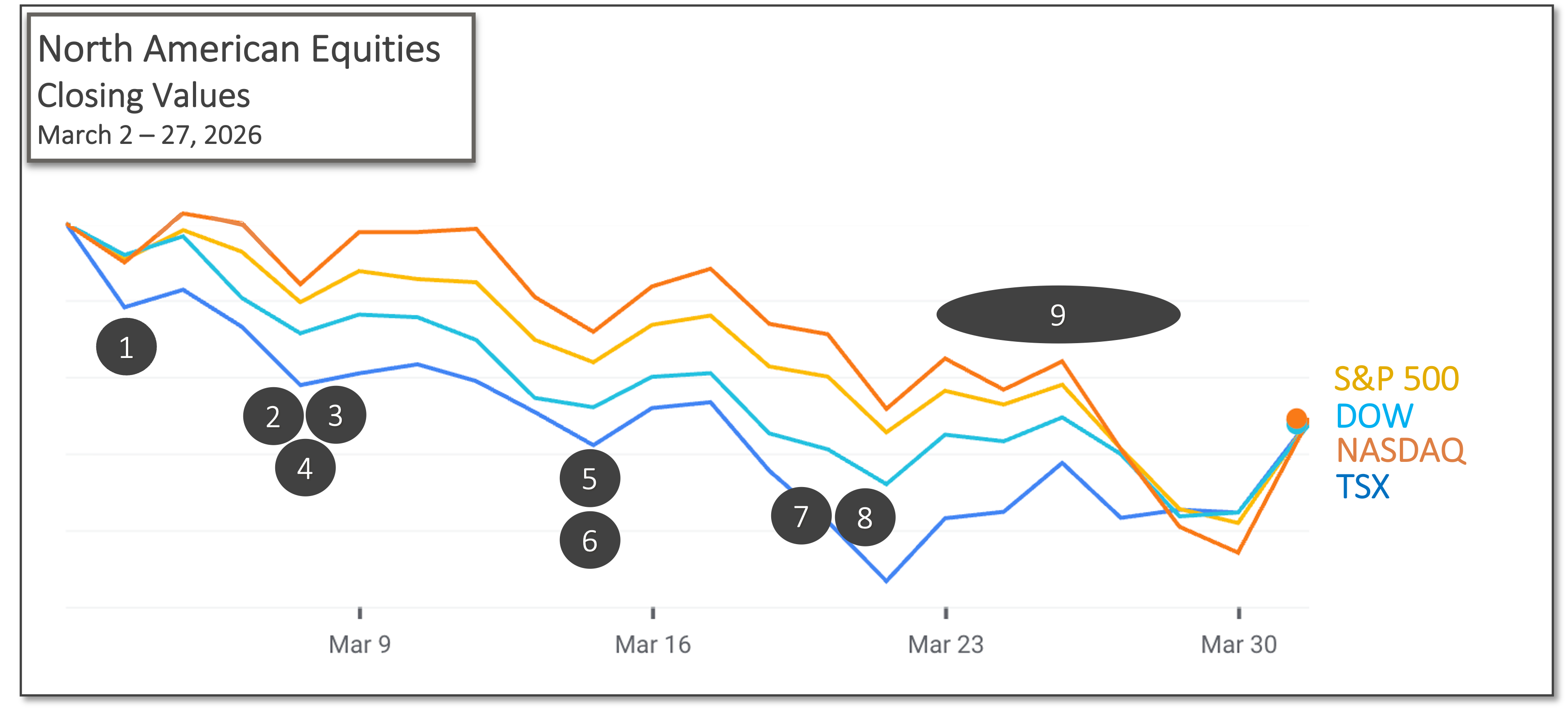
(source: Bloomberg https://www.bloomberg.com/marketsand ARG Inc. analysis)
Events that influenced markets in in March included:
1. March 3rd – Quarterly U.S. corporate results remained strong
Notwithstanding the negativity of geopolitical events, a bright spot for equities was the conclusion of the fourth quarter earnings results for the S&P 500. 73% of companies exceeded their earnings-per-share estimates and earnings growth was 14% higher, the fifth consecutive quarter of double-digit growth. FactSet Earnings Insight
2. March 6th – Oil prices rose and equities values fellMarch
The price of oil rose more than 35% in the first week of March to close at almost $91 USD per barrel for the West Texas Intermediate (WTI) benchmark. The rising price of oil sent corporate values downward (except for many energy and oil stocks) as increased energy prices threaten future revenue and profits. The contribution of energy price increased consumer inflation measures will likely delay, or reverse, rate cuts by the Federal Reserve, Bank of Canada and other central banks, potentially slowing economic expansion and profits.
3. March 6th – U.S. lost significant amount of employment
The loss in U.S. jobs added to market woes. The loss in U.S. jobs was not able to make a positive contribution to markets. The Bureau of Labor Statistics announced in its Employment Situation Summary that “payroll edged down by 92,000 in February, and the unemployment rate changed little at 4.4 percent.” The last time that the Bureau of Labor Statistics (BLS) delivered a significantly dissatisfying jobs report President Trump fired the lead statistician.
4. March 6th – Canadian trade diplomacy continued to protect our economy
Prime Minister Mark Carney pursued trade agreements with more reliable partners, which does not include the United States. Deals were struck with India, Australia and Japan, and further bilateral economic integration is being negotiated. CBC and Carney trade deals
5. March 13th – U.S. economy slowed down in Q4 2025
U.S. Gross Domestic Product (GDP) grew just 0.7 percent in the fourth quarter of 2025 according to the Commerce Department’s latest revision. The government shutdown was a large contributor to slower economic growth. For the full year of 2025, GDP grew 2.1 percent. CNBC and GDP
6. March 13th – Canadian employment dropped dramatically
Canada’s Labour Force Survey showed that employment declined by 84,000 in February, and the unemployment rate rose 0.2% to 6.7%. Employment fell in goods and services producing industries by 28,000 and 56,000, respectively.
7. March 13th – U.S. Consumer inflation in January stayed below 3% . . . for now
The Bureau of Economic Analysis reported that U.S. Federal Reserve’s preferred inflation indicator, the Personal Consumption Expenditures Price Index (PCE), increased 2.8 percent on a year-over-year basis in January. Core PCE, which excludes food and energy, increased by 3.1 percent. These figures are consistent with December’s levels. Unfortunately, the rise in energy prices since the war began was not reflected in these figures. BEA PCE release
8. March 18th – North American interest rates remained unchanged
The Bank of Canada’s overnight rate was held steady and has been 2.25% since October 29th, when the Bank reduced rates by ¼ percent. Canadian consumer inflation slowed in February, but Tiff Macklin’s announcement stated, “the sharp increase in global energy prices has led to increases in gasoline price, and this will push up total inflation in the coming months.” BoC release
The U.S. Federal Reserve maintained its federal funds rate in the range of 3½ to 3¾ percent after lowering it ¾ percent (75 basis points) from September to December 2025. Fed Chair Powell stated, “near-term inflation expectations have risen in recent weeks, likely reflecting the substantial rise in oil prices caused by supply disruptions in the Middle East.” The Fed’s Summary of Economic Projections indicated that inflation predictions have been increased since December. FOMC meeting info
9. March 19th – European Central Bank followed suit
The Governing Council of the ECB kept its interest rates unchanged, too. Europe’s consumer inflation has been close to 2% for a year, “but higher energy prices due to the war in the Middle East will drive inflation above our 2% target in the short term.” ECB summary
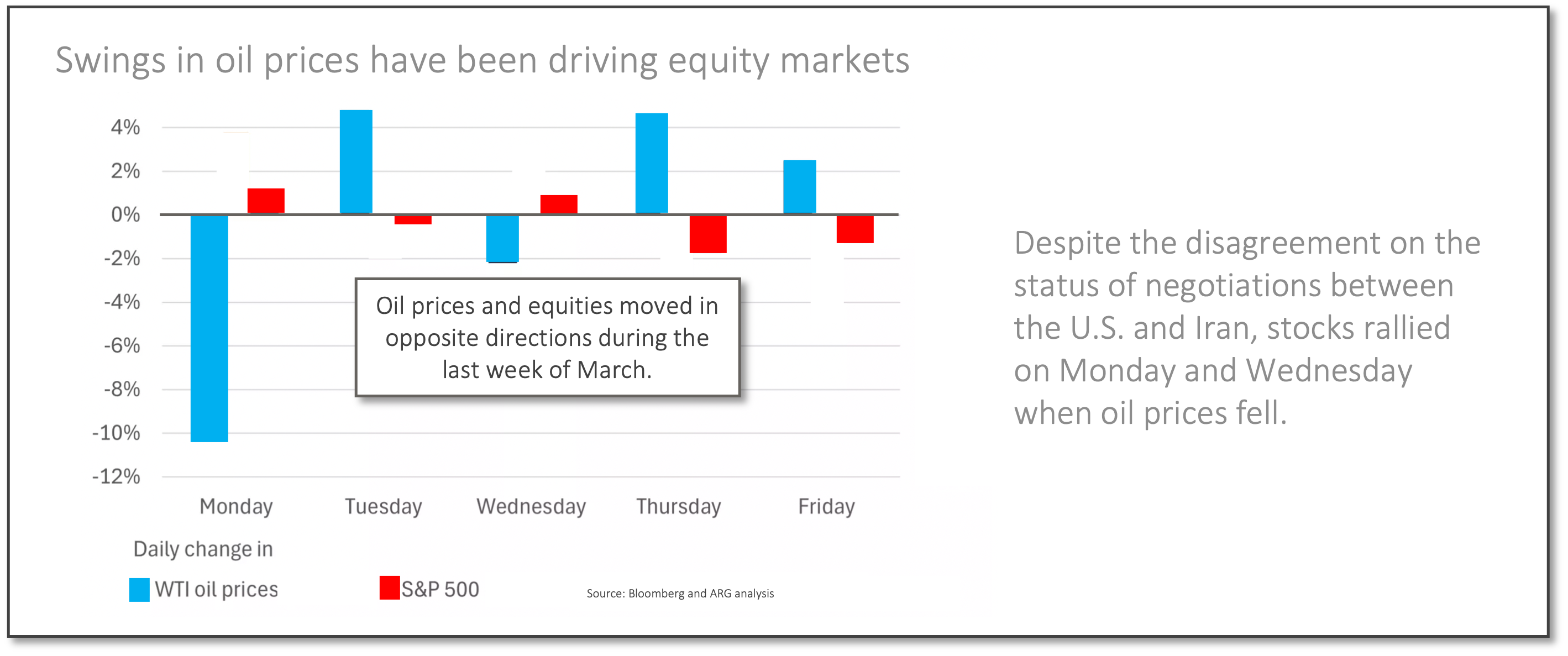
10. March 23rd to 27th – Oil prices and U.S. equities inversely related
During the last full week of March, oil and equities moved in opposite directions; as oil rose, equities fell and as prices fell, equities rose. On Monday, President Trump declared that progress had been achieved to negotiate an end to the war and oil prices plummeted, and equities jumped.
The largest influence on markets was the expanding conflict centred in Iran. Nearly twenty countries are directly involved, including NATO-member Turkey which could draw in many more.
What’s ahead for April and beyond?
The relationship between geopolitical tension, represented by the price of oil, and capital markets will continue for the foreseeable future. The supply-shock caused by the closing of the Strait of Hormuz has many similarities to the oil embargo on Western nationsimposed by the Organization of Arab Petroleum Exporting Countries in the 1970s.February end
If the expectation that higher oil prices will increase inflation occurs, it could affect monetary policy. It had appeared that progress against consumer inflation and employment losses would generate interest rate cuts by the Bank of Canada and the Federal Reserve. However, CME's Fedwatch tool shows that the U.S. rates will not be lowered soon, and Canadian rates are already below American rates. The next interest rate decision dates will arrive with updated inflation information, which will include the effects of increased energy prices.
The political risks posed by Increased inflation and slower economic growth should motivate U.S. leadership to resolve the conflict, especially as the midterm elections approach. A resolution to the war in Iran would logically lower volatility and political risk to markets. Politico and risk with Iran
On April 1st, Donald Trump delivered a 20-minute primetime address on the Iran war. His remarks were immediately interpreted by commodities traders, and the price of oil rose 10% further illustrating the close connections among geopolitics, military action, the Strait of Hormuz and commodity prices. Oil prices following national address
Ryan Gubic is the founder of MRG Wealth Management Inc. operating as MRG Wealth (“MRG”) and is a Portfolio Manager with MRG investments of Aligned Capital Partners Inc. (“ACPI”). The opinions expressed are not necessarily those of MRG, ACPI, or Ryan Gubic. This material is provided for general information and the opinions expressed and information provided herein are subject to change without notice. Every effort has been made to compile this material from reliable sources however no warranty can be made as to its accuracy or completeness. Before acting on the information presented, seek professional financial advice based on your personal circumstances. ACPI is a full-service investment dealer and a member of the Canadian Investor Protection Fund (“CIPF”) and the Canadian Investment Regulatory Organization (“CIRO”). Investment services are provided through MRG Investments, an approved trade name of ACPI. Only investment-related products and services are offered through MRG Investments of ACPI and covered by the CIPF. Financial planning and insurance services are provided through MRG. MRG is an independent company separate and distinct from MRG Investments of ACPI.
Dollars and Sense
Discover more
Dive into some advice directly from our Founder and Personal CFO.

What Happened in the Markets in September 2026