

What Happened in the Markets October 2026
October markets were mixed and volatile as conflict, rising oil prices and inflation weighed on investors. Canada raised rates, while the U.S. Fed held steady.

Written by
Ryan Gubic
Published on
3
Nov 2026
Copy link
Last Month in the Markets: October 1st – 30th, 2026
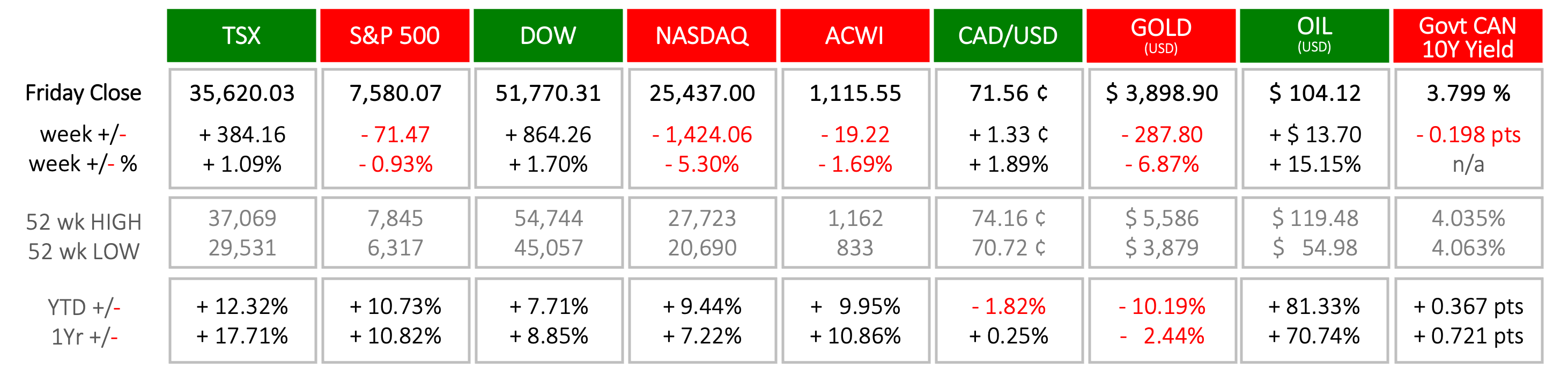
Index returns based on index value (source: Bloomberg https://www.bloomberg.com/markets, MSCI https://www.msci.com/end-of-day-data-search and ARG Inc. analysis. Price returns are reflected)
What happened in October?
Equity markets delivered mixed results and increasing volatility in October. Even the volatility of the Volatility Index has become more volatile in the second half of last month. The sources of unsatisfying results and volatility are not a mystery, they include, but are not limited to the following:
· The U.S. /Iran war continues. The restriction of oil shipments through the Strait of Hormuz and the Bab al-Mandab Strait at the southern end of the Red Sea has pushed the price of oil back towards its 52-week high. The price has risen more than 80% in 2026.
· Energy (crude oil, gas, diesel, etc.) is a component cost of nearly every product and service, and increased energy prices will drive the price inflation of almost everything else.
· Increasing and persistent inflation will eventually require monetary policy from central banks to temper inflation. The speculation and timing of interest rate increases influence price expectations of stocks and bonds.
· Restrictive trade practices (i.e. tariffs) initiated by the U.S. president have also contributed to domestic and import/export inflation around the world.
· Political uncertainty in the U.S. as the midterm elections could have the balance of power shift from the Republicans to the Democrats in the House of Representatives and the Senate. Until, and even perhaps after, the election is decided will the legislative waters calm.
What’s ahead for November and beyond?
The return to stability would be welcomed by all but the most adventurous investors. Geopolitical conflict must subside to allow energy prices to fall, then inflation can no longer be pushed along, international diplomacy must manifest itself through trade treaties and the legislatures and governmental bodies in the U.S. must perform more consistently to promote a return to predictability and performance.
The Bank of Canada and U.S. Federal Reserve will announce interest rate decisions on December 9th. The currently predicted U.S. rate increase (75% likelihood according to CME's FedWatch tool) would begin to slow the economy and the growth of inflation if it occurs. After the recent Bank of Canada increase, it is less likely that the next announcement would bring a rate hike.
The results of the elections could influence markets but typically do not deliver the dire consequences that unsuccessful candidates suggest. Read CNBC's analysis of midterm election effects on markets to see that markets often perform well once election jitters subside and when House and Senate majorities are aligned, which is the current prediction.
For families seeking professional wealth management in Calgary, understanding what drives market returns, and how those developments impact your long-term financial plan, is where working with a trusted Personal CFO can make all the difference.
Events that influenced markets in October included:
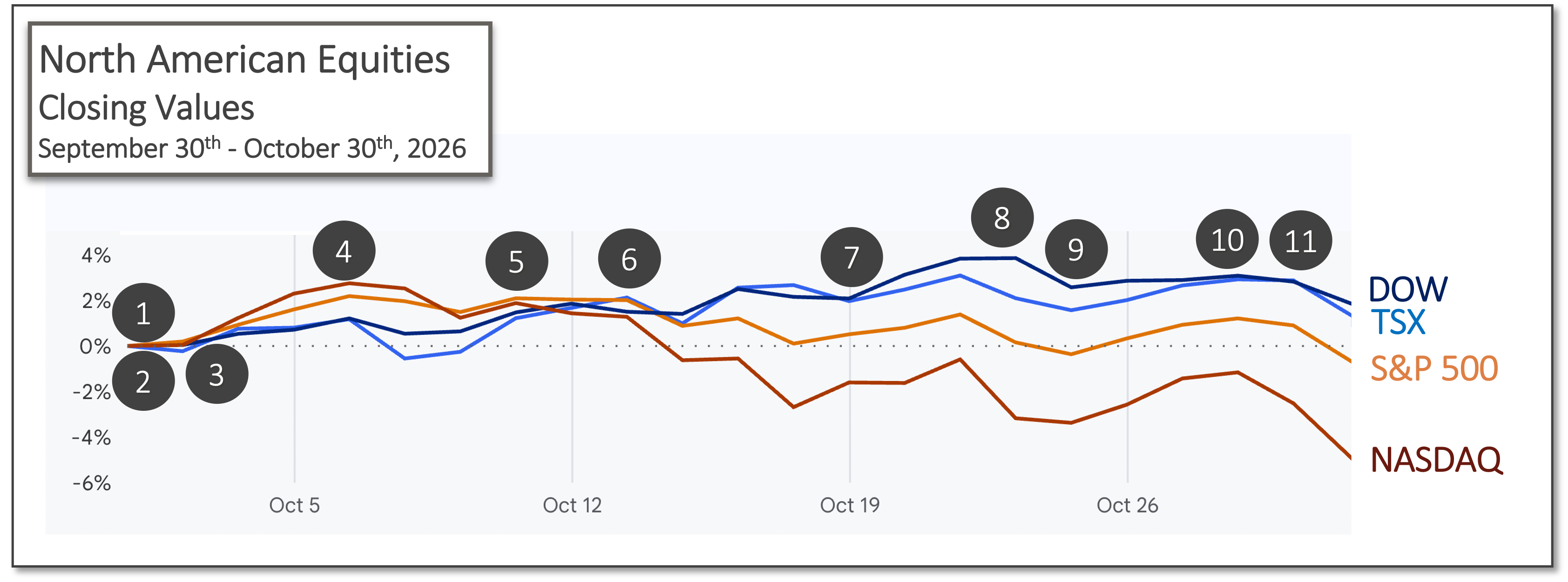
(source: Bloomberg https://www.bloomberg.com/marketsand ARG Inc. analysis)
1. September 29th and 30th – Canada’s economy unchanged in July, while U.S. expanded
Real Gross Domestic Product (GDP) was unchanged in July. Neither Goods-producing nor Services-producing industries generated growth in July. One bright spot was the construction sector which saw its fourth consecutive month of growth after rising 1.3% in July. StatsCan release
U.S. GDP increased at an annual rate of 2.2 percent in the second quarter of 2026 according to the third estimate by the Bureau of Economic Analysis. Previous estimates had pegged the economic growth rate at 1.5 percent for the same period but have been revised upward. BEA release
2. September 30th – U.S. inflation continued its rise
The Personal Consumption Expenditures (PCE) price index, the Federal Reserve’s preferred inflation indicator, increased 0.3 percent in August, and 3.4% on a year-over-year basis. Core PCE, which excludes food and energy, increased 3.0 percent. Both headline and core measures are above the Fed’s 2 percent goal. PCE release CNBC and PCE
3. October 2nd - U.S. employment growth stalled
The U.S. Bureau of Labor Statistics reported, “Both nonfarm payroll employment (+29,000) and the unemployment rate (4.2 percent) changed little in September.” The number of unemployed people, 7.1 million, and long-term unemployed, 1.9 million people, were also stagnant. Most industries saw limited gains or losses. BLS ESS release
4. October 6th – U.S. trade deficit grew, and Canada surplus expanded again
The U.S. Census Bureau and the U.S. Bureau of Economic Analysis announced that the goods and services deficit was $105.6 Billion in August, up almost $13 Billion from July’s $92.8 Billion trade deficit. Imports jumped 4.3% and exports increased 1.4% during August. The trade deficit for goods increased to $137 Billion while the service surplus was unchanged at $31 Billion. BEA release
The Canadian merchandise trade surplus grew for the sixth consecutive month in August. Exports rose 2.5% and imports were down 2.0% to drive the surplus to $4.2 Billion up from $787 Million in July. Some of the increase is attributed to changes in the Canadian dollar since much of the trade is conducted in U.S. dollars and then converted or calculations in Canadian dollars. Nonetheless exports increased in 8 of 11 sectors including a 17% increase in refined petroleum energy products. StatsCan release
5. October 9th – Canadian employment fell
Employment declined by 68,000 in September and the unemployment rate increased 0.1% to 6.5%. The decrease was split evenly between full-time and part-time employees. Losses were highest in Quebec and British Columbia, among youth and core aged women, and in educational services, health care and social assistance, and manufacturing. StatsCan Labour Force Survey
6. October 14th – U.S. consumer inflation rose higher above goal
Consumer Price Index (CPI) increased 0.6 percent in September after rising 0.4 percent in August. Over the last 12 months the all-items index increased 3.7 percent, up from 3.4 percent in August. The increase in September was driven by a 9.1 percent increase in the index for gasoline, which accounted for half the monthly increase. BLS CPI release
7. October 19th – Canadian consumer prices edged upward
The Consumer Price Index (CPI) rose 3.1% year-over-year in September following a 3.0% increase in August. Gasoline led the increase in the headline inflation rate, excluding gasoline CPI rose 2.2%. Core CPI which excludes energy and food was slightly higher at 2.4%. StatsCan CPI release
8. October 22nd – Producer price inflation jumped in Canada
“Prices of products manufactured in Canada, as measured by the Industrial Product Price Index (IPPI) rose 2.0% in September and gained 14.5% year over year”, according to the latest IPPI release from StatsCan.
9. October 23rd – Retail sales maintained strong pace
Retail sales in Canada rose 1.2% in August. Total sales reached $74.6 billion after all nine subsectors and six provinces increased, led by increases at motor vehicle and parts dealers. It was a turnaround from July’s 0.7% decline. StatsCan retail sales
10. October 28th – Central banks announced interest rate decisions
The Bank of Canada, which faces a difficult task to speed up a slowing economy and slow down increasing inflation, raised interest rates for the first time in 3 years. The policy interest rate, the overnight rate, increased ¼ percent (25 basis points) to 2½%. BoC release CBC and BoC
The U.S. Federal Reserve’s Federal Open Market Committee “decided to maintain the target range for the federal funds rate at 3¾ to 4 percent” in their statement on Wednesday afternoon. A rate increase was not expected, but it is predicted for December 9th according to CME's FedWatch tool.
11. October 29th – U.S. inflation rose, again
A Federal Reserve rate “hold” occurred despite the U.S. Bureau of Economic Activity reporting the Personal Consumption Expenditures price index (PCE) rose 0.5% in September and 3.6% since last year. PCE is the Federal Reserve’s preferred inflation measure and sits above the 2% goal. BEA PCE release BEA GDP release
Ryan Gubic is the founder of MRG Wealth Management Inc. operating as MRG Wealth (“MRG”) and is a Portfolio Manager with MRG investments of Aligned Capital Partners Inc. (“ACPI”). The opinions expressed are not necessarily those of MRG, ACPI, or Ryan Gubic. This material is provided for general information and the opinions expressed and information provided herein are subject to change without notice. Every effort has been made to compile this material from reliable sources however no warranty can be made as to its accuracy or completeness. Before acting on the information presented, seek professional financial advice based on your personal circumstances. ACPI is a full-service investment dealer and a member of the Canadian Investor Protection Fund (“CIPF”) and the Canadian Investment Regulatory Organization (“CIRO”). Investment services are provided through MRG Investments, an approved trade name of ACPI. Only investment-related products and services are offered through MRG Investments of ACPI and covered by the CIPF. Financial planning and insurance services are provided through MRG. MRG is an independent company separate and distinct from MRG Investments of ACPI.
Dollars and Sense
Discover more
Dive into some advice directly from our Founder and Personal CFO.

Your Financial Plan Looks Great, But Does Your Estate Plan Actually Support It?