

What Happened in the Markets in April 2026
North American equities rose in April despite Middle East conflict, oil price spikes, and central banks holding rates unchanged amid rising inflation.

Written by
Ryan Gubic
Published on
5
May 2026
Copy link
Last Month in the Markets: April 1st – 30th, 2026
What happened in April?
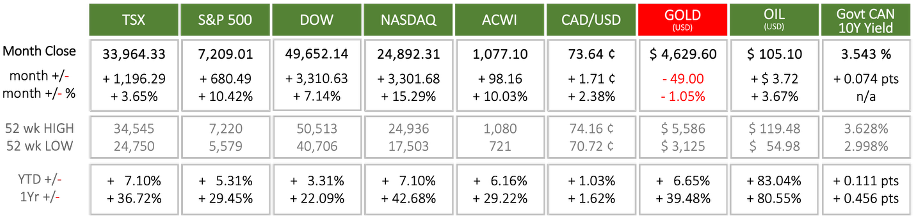
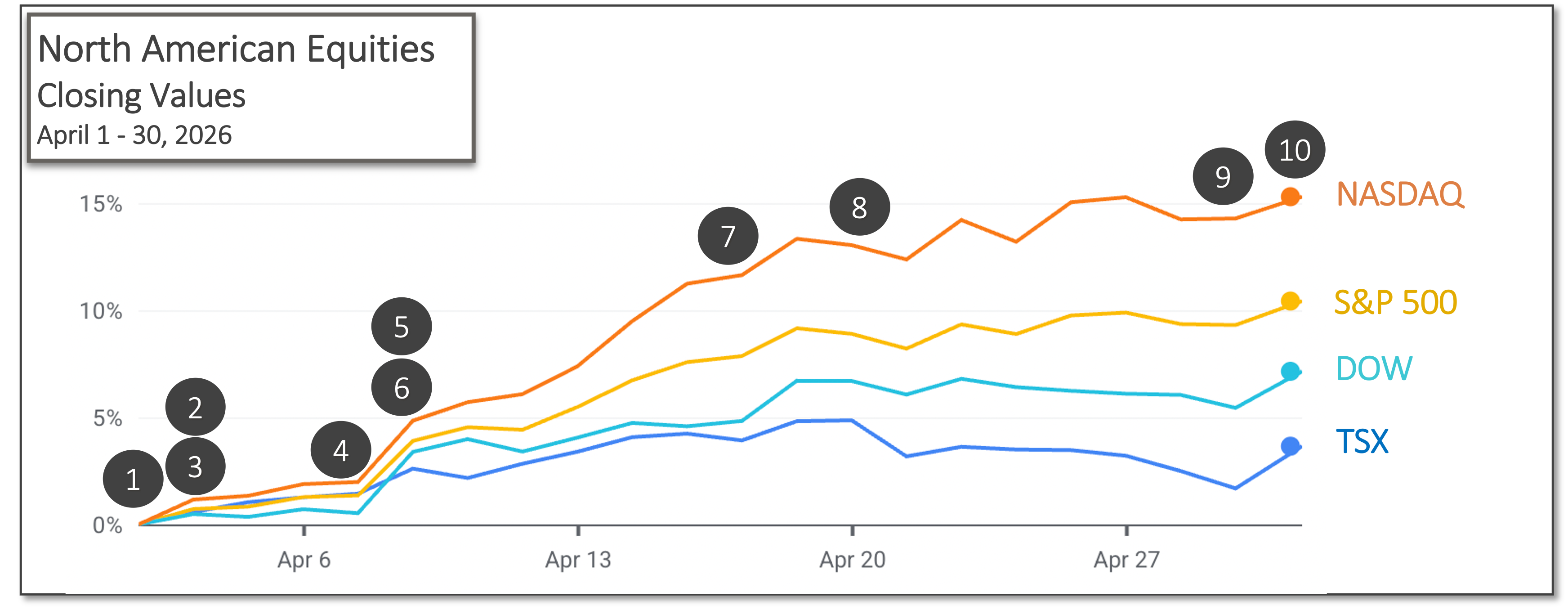
The market results of last month belie the political, humanitarian and military turmoil occupying most people’s attention. North American equity indexes rose 3½ to 15 percent during April. This performance brought all of the U.S. indexes back into positive territory for year-to-date performance. The TSX remained in first place for this measure at 7.10% and now shares this position with the NASDAQ. For these four indexes, the 1-year performance ranges from 22 to 42 percent, which represents a healthy return despite the events of the last twelve months. For families focused on wealth management in Calgary, understanding what drives these results - and what they mean for your financial plan - is exactly where a Personal CFO relationship adds value.
As the values of indexes have risen the volatility has calmed, thankfully, in April, which for some investors can be nearly as important as the prices of underlying equities. VIX volatility index
(source: Bloomberg https://www.bloomberg.com/marketsand ARG Inc. analysis)
Events that influenced markets in in April included:
1. April 1st – Trump spoke and oil jumped, again
Trump addressed the nation on regarding his war with Iran. West Texas Intermediate, the global benchmark another 14% from just prior to his address. Crude oil prices
2. April 2nd – Canada’s trade deficit grew overall and shrank with the U.S.
Canada’s merchandise trade widened from $4.2 billion in January to $5.7 billion in February. Canada’s trade surplus with the U.S. narrowed to $1.7 billion in February from $4.9 billion in January. StatsCan release
3. April 2nd – U.S. jobs market reversed February’s losses
The Bureau of Labor Statistics’ Employment Situation Summary that 178,000 jobs were added in March, a reversal from 133,000 job losses in February and far beyond the consensus of analysts. Unemployment changed little at 4.3% in March. CNBC and jobs
4. April 9th – American inflation had been approaching its target
The Federal Reserve’s preferred inflation indicator, the Personal Consumption Expenditures price index (PCE) rose to 2.8% for all-items and excluding food and energy Core PCE rose 3% in February. PCE release CNBC and PCE
5. April 10th – Canadian jobs also reversed previous months losses, but with small gain
In March the Canadian economy added 14,000 jobs. This gain is a significant improvement from February’s loss of 84,000 jobs. Statscan’s Labour Force Survey reported that the unemployment rate was unchanged at 6.7%. CBC and LFS
6. April 10th – U.S. CPI reflected increased oil and gas prices
The Bureau of Labor Statistics provided the Consumer Price Index rose 0.9% in March and 3.3% on a year-over-year basis. This data set included the effects of the U.S./Iran war as the index for energy rose 10.9 percent. Nearly three-quarters of the monthly increase to inflation was delivered by the 21.2 percent increase in the price of gasoline. BLS and CPI
7. April 17th – Diplomacy helped lower oil prices temporarily
Negotiations between the U.S. and Iran achieved some progress, and markets responded. Increasing oil shipments through the Strait of Hormuz drove the price of oil below $84/barrel, down 25% from its closing price of April 6th.
8. April 20th – Canadian consumer inflation rose dramatically
StatsCan reported that the Consumer Price Index (CPI) increased 2.4% in March on a year-over-year basis, up from February’s 1.8%. March saw the largest monthly increase for the price of gasoline on record as prices surged 21.2% due to the conflict in the Middle East.
9. April 29th – Central banks held rates unchanged
Canadian, American and European institutions held their policy interest rates unchanged.
· The Bank of Canada maintained its target for the overnight rate at 2.25%, with the Bank Rate at 2.50% and the deposit rate at 2.20%. BoC release
· The Federal Reserve held the range for the federal funds rate at 3½ to 3¾ percent. Fed FOMC
· The European Central Bank kept the interest rates on the deposit facility, the main refinancing operations and the marginal lending facility unchanged at 2.00%, 2.15% and 2.40% respectively. ECB release
10. April 30th – U.S. GDP rose after government shut-down ended
U.S. Gross Domestic Product (GDP) grew at an annualized rate of 2.0% in the first quarter of 2026. The increase from Q4’s 0.5% can be attributed to an increase in government spending after the shut-down ended and the rising exports despite decelerating consumer spending. BEA GDP release
The largest influence on markets was the expanding conflict centred in Iran. Nearly twenty countries are directly involved, including NATO-member Turkey which could draw in many more.
What’s ahead for May and beyond?
Central banks have signaled that interest rate cuts will be delayed by the recent spike in consumer inflation. The Bank of Canada and Federal Reserve next announce rates on June 10th and 17th, respectively.
The largest influence over markets for the foreseeable future remains the situation in the Middle East and its impact on the global price of oil. Directly and indirectly the supply-shock has increased consumer inflation and will continue to do so until it returns to pre-conflict levels.
If you have questions about what this means for your financial life, book a 30-minute intro call - no obligation, just clarity on where you stand.
Ryan Gubic is the founder of MRG Wealth Management Inc. operating as MRG Wealth (“MRG”) and is a Portfolio Manager with MRG investments of Aligned Capital Partners Inc. (“ACPI”). The opinions expressed are not necessarily those of MRG, ACPI, or Ryan Gubic. This material is provided for general information and the opinions expressed and information provided herein are subject to change without notice. Every effort has been made to compile this material from reliable sources however no warranty can be made as to its accuracy or completeness. Before acting on the information presented, seek professional financial advice based on your personal circumstances. ACPI is a full-service investment dealer and a member of the Canadian Investor Protection Fund (“CIPF”) and the Canadian Investment Regulatory Organization (“CIRO”). Investment services are provided through MRG Investments, an approved trade name of ACPI. Only investment-related products and services are offered through MRG Investments of ACPI and covered by the CIPF. Financial planning and insurance services are provided through MRG. MRG is an independent company separate and distinct from MRG Investments of ACPI.
Dollars and Sense
Discover more
Dive into some advice directly from our Founder and Personal CFO.
What Happened in the Markets in August 2026